


How AI Automation Helps Tampa Businesses Grow
AI automation for Tampa businesses can capture and qualify leads when staff are unavailable, then route them into a CRM for timely follow-up. The strongest approach combines an after-hours AI voice agent or chatbot with clear qualification rules, human oversight, and revenue-focused measurement—not assumptions or guarantees.
Why do Tampa businesses need AI automation?
Local businesses often lose opportunities in ordinary moments:
- A prospective customer calls after closing time.
- A team member is serving another customer and cannot answer.
- A website visitor has a question but does not want to complete a long form.
- A lead arrives on a weekend and waits until Monday for a response.
- A busy owner has no consistent process for follow-up.
These gaps are especially important for service businesses, where a missed conversation can mean a missed appointment or estimate request. AI automation does not replace every customer interaction. Instead, it helps a business respond consistently, collect useful information, and hand the conversation to a person when human judgment is needed.
For Tampa Bay businesses, the practical goal is not to add technology for its own sake. It is to create a connected process from first contact to qualified opportunity, booked appointment, and follow-up.
What can an after-hours AI voice agent do?
An after-hours AI voice agent is a phone-based system that can answer calls, explain basic information, ask programmed questions, record responses, and route urgent or qualified requests. Depending on the business and implementation, it may be able to:
- Answer calls outside normal business hours.
- Identify the caller’s reason for contacting the business.
- Gather details such as location, service need, timing, and contact information.
- Recognize situations that should be escalated to a person.
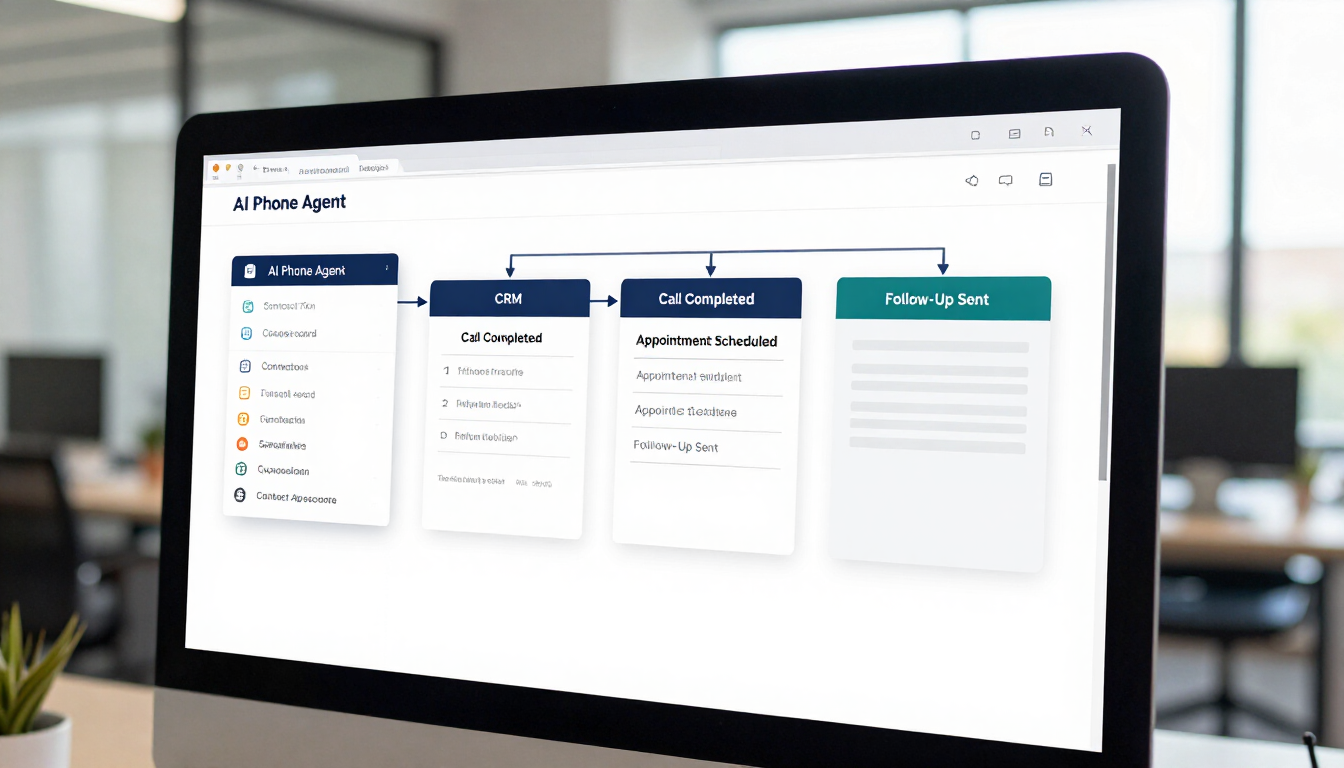
- Send call details to a CRM or follow-up workflow.
- Offer a next step, such as a booking link or callback request.
The agent should be designed around the business’s actual intake process. A contractor may need a property address and type of repair. A real estate team may need location, buying or selling timeline, budget range, and financing status. A medical practice may need a different set of questions and strict privacy controls.
An AI voice agent should also clearly identify itself as an automated assistant where appropriate. The experience should be useful, transparent, and easy for callers to exit or transfer to a person.
What does lead qualification automation involve?
Lead qualification automation turns an unstructured inquiry into information a team can act on. The system asks consistent questions, applies agreed-upon rules, and labels the lead according to its next best action.
A simple qualification model might classify inquiries as:
- Ready for a conversation: The lead fits the service area and has a clear need.
- Needs review: The lead may fit, but an employee should confirm details.
- Nurture: The timing is uncertain, so the lead enters helpful follow-up.
- Not a fit: The request falls outside the company’s service, location, or policy.
Qualification rules should be written before the AI system is built. Otherwise, the automation may collect information without helping the team make decisions.
For example, a Tampa HVAC company could define a qualified call using service location, type of issue, urgency, and customer availability. A real estate team could use buyer or seller status, preferred area, timeline, and financing details. The rules should reflect the business—not a generic script.
What do Reprise AI case studies show?
Publicly described Reprise AI case studies provide useful third-party examples of how businesses have applied AI phone and lead qualification systems. These examples should be treated as directional case studies, not guarantees for another company and not results produced by Arthur’s Creatives.
Tampa HVAC after-hours example
Reprise AI publicly describes a Tampa HVAC contractor that used an after-hours voice agent to handle calls when the office was unavailable. Reprise AI reports that the system helped recover $340,000 per year in after-hours revenue .
That figure is a claim attributed to Reprise AI. Businesses evaluating a similar system should verify the source, definitions, time period, and measurement method before using it as a forecast. The example is still useful because it highlights a common operational problem: calls can arrive when the team cannot answer, even though the caller may have an immediate need.
The relevant lesson is not “every business will generate the same amount.” It is to examine how many calls arrive after hours, how many are missed, which requests are valuable, and whether a consistent response could create more opportunities.
Real estate lead qualification example
Reprise AI also publicly describes a real estate team lead qualification case study. The use case focuses on handling inquiries, asking qualifying questions, and helping the team distinguish stronger opportunities from less-ready or incomplete leads.
For a real estate team, qualification can help organize information such as preferred neighborhoods, purchase or selling timeline, financing status, property type, and next steps. The workflow may then create or update a CRM record and notify the appropriate team member.
The broader takeaway is that AI can support prioritization before a salesperson spends time on a conversation. It should not make unsupported promises, give regulated advice, or make decisions that require professional judgment.
Some business owners searching for an agency in Tampa FL Reprise or a Reprise AI case study may be comparing vendors and examples. A careful comparison should look beyond headline results and ask how the system was implemented, what integrations were used, and how outcomes were measured.
Where do leads leak from your current process?
Before selecting software, map the customer journey from first contact to booked appointment or sale. Look for points where a lead can disappear, wait too long, or receive an inconsistent response.
Review:
- Missed calls during evenings, weekends, holidays, and busy periods.
- Contact forms that receive no prompt acknowledgment.
- Website chats that are not connected to a human follow-up process.
- Leads stored in inboxes, spreadsheets, or disconnected applications.
- Repeated questions that staff answer manually every day.
- Appointments that are requested but never confirmed.
Start with actual records when possible. Review call logs, form submissions, CRM stages, booking data, and staff feedback. This creates a baseline and prevents the project from being based only on impressions.
A business may discover that its largest issue is not after-hours calls. It might be slow weekday follow-up, unclear service-area rules, or a CRM that nobody updates. AI automation should address the most expensive or frequent leak first.
How do you implement AI automation step by step?
1. Define the business outcome
Choose a specific operational goal, such as capturing more after-hours inquiries, reducing manual qualification, improving callback consistency, or increasing completed booking requests. Avoid vague objectives such as “use AI.”
Decide what the system should do and what it should not do. For example, it may collect information and request a callback, but it may not quote a final price or promise a service time without staff confirmation.
2. Write qualification rules
Document the questions and decision points in plain language. Include service area, customer need, urgency, budget or timeline when relevant, and the conditions that require a human handoff.
Keep the first interaction focused. Asking too many questions can frustrate callers and website visitors. Prioritize the information the team genuinely needs to choose the next step.
3. Build the voice agent or chatbot
Create the conversation flow for the selected channel. A voice agent needs natural call prompts, interruption handling, voicemail behavior, and escalation instructions. A chatbot needs readable messages, clear buttons or prompts, and an easy path to contact a person.
The system should use approved business information and avoid inventing answers. If it does not know something, it should say so and offer a human follow-up.
4. Connect the CRM and n8n follow-up
The automation becomes more useful when conversations lead to organized records. A workflow may:
- Create or update a contact.
- Add the source and conversation summary.
- Apply a qualification label.
- Notify a sales or service team member.
- Send a confirmation message.
- Create a callback task.
- Start an appropriate nurture sequence.
n8n can help connect systems and orchestrate these steps, but the workflow should remain understandable and maintainable. Document what happens when a CRM record is missing, a message fails, or a lead requests a person.
Businesses exploring broader options can review AI automation services or learn more about AI lead qualification for Tampa real estate teams .
5. Test realistic conversations
Test more than the ideal path. Include accents, interruptions, incomplete answers, angry callers, duplicate leads, wrong numbers, service-area questions, urgent requests, and requests the business cannot fulfill.
Have staff review transcripts, summaries, CRM records, and notifications. Confirm that the system does not create duplicate tasks or send a lead to the wrong person.
6. Launch with human oversight
Begin with a defined monitoring period. Staff should know how to review interactions, correct incorrect records, update scripts, and report failure patterns. Automation needs maintenance as services, hours, pricing policies, and team responsibilities change.
7. Measure revenue-related operating metrics
Do not judge the system only by the number of calls answered or messages sent. Track a group of metrics that connects activity to business outcomes:
- Missed-call rate before and after implementation.
- Speed to lead and time to human follow-up.
- Qualified inquiries by source and channel.
- Booked appointments and completed appointments.
- Contact, booking, and conversion rates where data is available.
- Revenue associated with tracked opportunities, using a consistent definition.
Measurement should account for seasonality, marketing changes, staffing, and data quality. A reported increase in activity is not automatically proof of revenue growth.
How should Tampa businesses choose an implementation partner?
A partner should be able to explain the system in business terms, not only list software features. Ask how the provider will:
- Map the current lead journey.
- Define qualification and escalation rules.
- Protect customer information.
- Connect the phone system, chatbot, CRM, calendar, and automation tools.
- Test edge cases and review transcripts.
- Provide documentation and ongoing support.
- Separate measured results from forecasts or assumptions.
The best solution may be small at first. One phone line, one service area, one qualification workflow, and a clear reporting process can be easier to improve than a complex system launched everywhere at once.
Arthur’s Creatives helps Tampa-area small businesses plan and build connected websites, AI phone agents, chatbots, CRM systems, and business automation. The work begins with understanding the operational problem and selecting technology that supports it. You can explore the Services , review digital solutions for growing businesses , or contact Arthur’s Creatives to discuss your process.
Questions to ask before launching
Will AI automation replace my staff?
Usually, the practical role is to support staff by handling repetitive intake, basic questions, and routing. Human involvement remains important for complex, sensitive, urgent, or high-value conversations.
Can an AI agent guarantee more revenue?
No. Results depend on call volume, lead quality, offer, follow-up, implementation, customer behavior, and measurement. Third-party case studies such as the examples described by Reprise AI should not be treated as guarantees.
Should every business start with a voice agent?
Not necessarily. A chatbot, improved contact form, CRM workflow, or faster human callback process may be the better first step. The right starting point depends on where the business is losing opportunities.
Key takeaways for Tampa business owners
AI automation can help Tampa businesses respond to leads more consistently, especially when staff are unavailable. The strongest implementation starts by finding process leaks, defining practical qualification rules, and connecting an AI voice agent or chatbot to the CRM and follow-up system. Public Reprise AI case studies—including the Tampa HVAC example and real estate qualification example—can provide ideas, but their reported outcomes are not promises for another business. Next, review your missed calls, response times, booked appointments, and revenue tracking. Then choose a manageable workflow to test, measure, and improve with appropriate human oversight.